
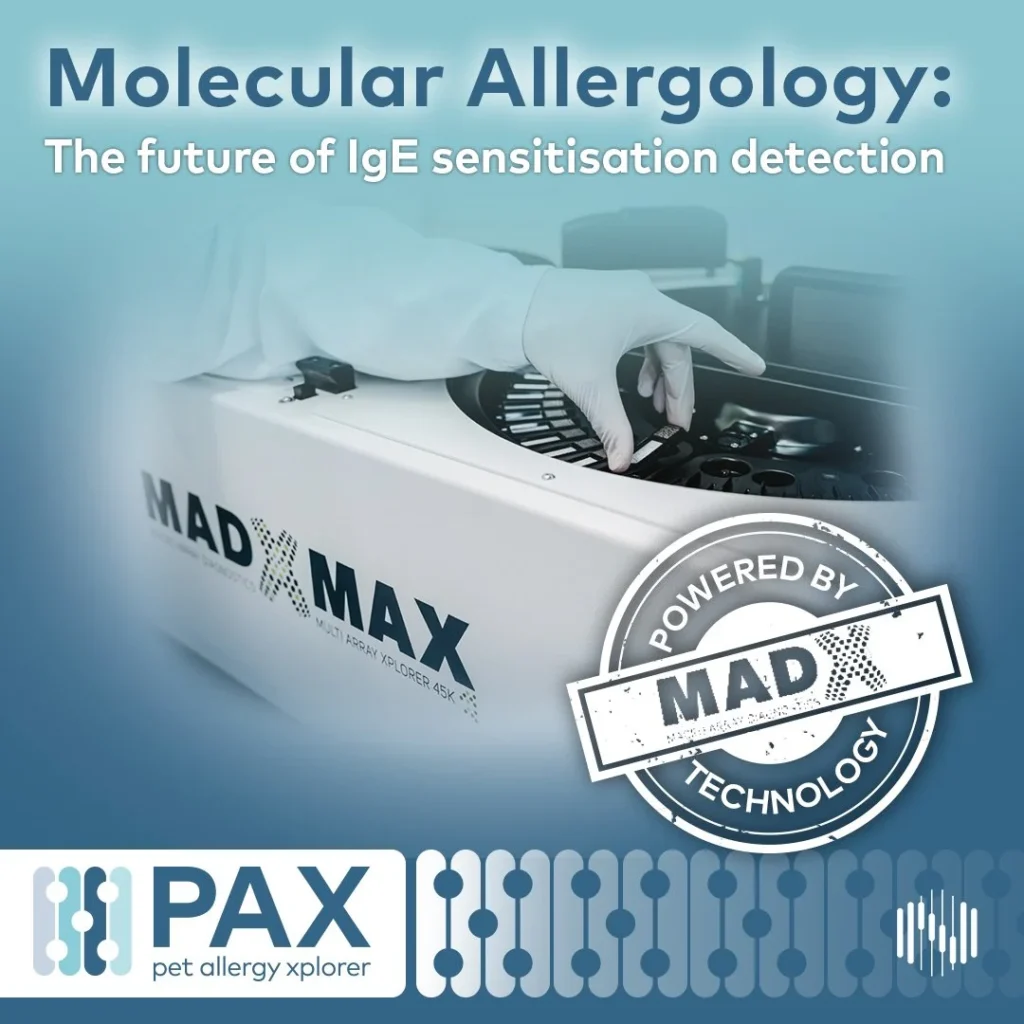
Accurate allergy diagnosis remains one of the most challenging aspects of veterinary dermatology. Allergic skin diseases are common in companion animals, yet traditional diagnostic methods often provide inconsistent or incomplete results. To address these limitations, molecular allergology has emerged as a more precise and reliable approach. One of the most significant innovations in this field is Pet Allergy Xplorer (PAX), the first commercial molecular serum IgE-specific test developed specifically for pets.
Limitations of Conventional Allergy Testing
For decades, allergy testing in veterinary medicine has relied largely on enzyme-linked immunoassays (ELISA) using allergen extracts. In this method, extracts derived from whole allergens are incubated with a patient’s serum to detect immunoglobulin E (IgE) antibodies. While widely used, this technique has several inherent weaknesses.
Allergen extracts can vary significantly depending on how they are produced, purified, and standardized. This variability may lead to inconsistent results between laboratories or even between different batches of the same extract. Moreover, extracts often contain thousands of proteins, of which only a small fraction are clinically relevant allergens. If the concentration of a specific allergenic protein is low, the test may fail to detect a genuine sensitization, resulting in false-negative findings.
A classic example is house dust mite allergy. Although house dust mites contain thousands of proteins, only a limited number are known to trigger allergic reactions. When whole extracts are used, these relevant proteins may be underrepresented, particularly in animals with low IgE levels. This makes precise diagnosis and targeted treatment more difficult.
Molecular Allergology as a Solution
Molecular allergology offers a more refined diagnostic approach by focusing on individual allergenic proteins rather than whole extracts. These proteins are purified or produced using recombinant technology, resulting in a higher level of standardization and reproducibility. In human medicine, molecular allergology has been widely adopted to identify specific sensitizations and improve clinical outcomes.
Building on this proven concept, Macro Array Diagnostics developed the Allergy Explorer (ALEX) for human patients, followed by the Food Xplorer (FOX) for food intolerance testing. Recognizing the potential benefits for veterinary medicine, Nextmune partnered with Macro Array Diagnostics to develop Pet Allergy Xplorer (PAX).
What Makes PAX Different
PAX is the first serological IgE-specific test for pets that combines traditional allergen extracts with molecular allergen components in a single diagnostic platform. This hybrid approach allows veterinarians to identify not only which allergens are involved, but also which specific proteins are responsible for the allergic response.
One of the key advantages of PAX is its improved reproducibility. The testing arrays are manufactured using advanced robotic technology, minimizing human error and ensuring consistent quality. Automated processes are also used during serum handling and analysis, further enhancing accuracy.
PAX is designed to identify cross-reactivity between allergens, an important factor in complex allergy cases. It can also help clarify polysensitization by distinguishing primary allergens from secondary or cross-reactive ones. Additionally, the test provides individualized results based on the pet’s species and geographic region, making the findings more clinically relevant.
Another notable feature is the extensive data output. While conventional serum allergy tests typically evaluate fewer than 100 parameters, the PAX cartridge contains up to 300 testing positions, including both extracts and molecular components. Built-in controls ensure sample quality and proper test performance, while specific technology blocks cross-reactive carbohydrate determinants (CCD) that can otherwise lead to false-positive results.
Impact on Veterinary Practice
By delivering more accurate and detailed information, PAX supports more informed clinical decision-making and improves the selection of allergens for immunotherapy. As additional data are collected, the platform will continue to evolve, enabling the identification of new allergenic components and further refinement of diagnostic precision.
Currently, Nextmune is the only veterinary diagnostic laboratory offering molecular allergology testing. PAX represents a significant step forward in allergy diagnostics, with the potential to improve both diagnostic confidence and long-term treatment outcomes for allergic pets.
Source:
Nextmune – Pet Allergy Xplorer (PAX)
https://nextmune.com/pets/blog-news/en-be/pax/petallergyxplorer
Author:
Dr. Thierry Olivry, DrVet, PhD, DipECVD, DipACVD